You fell because a property owner
failed to keep their premises safe.
Before they tell you it was your fault for not watching where you were walking — talk to an attorney who knows exactly how to answer that argument.
Trip and fall cases — legally called premises liability claims — are among the most aggressively defended personal injury cases. The moment you report a fall, the property owner's insurance company begins building a case that it was your fault. Their standard playbook is simple and cynical: blame the victim.
"You should have watched where you were going" is not a defense. It is a deflection — and we know exactly how to counter it."
California premises liability law places a clear duty on property owners to maintain safe conditions for visitors. That duty doesn't disappear because someone was walking normally through a store, on a sidewalk, or across a parking lot. The question is not whether you were perfectly attentive — it is whether the hazard was unreasonably dangerous. Those are very different questions, and the distinction matters enormously.
Evidence disappears within hours — not days
In trip and fall cases, the scene is your most critical evidence — and it is almost always altered or repaired within hours. Property owners and their insurers know this. A cracked sidewalk gets patched. A wet floor gets dried and the sign removed. A broken step gets fixed. The exact condition that caused your fall may not exist by tomorrow morning.
We go to the scene immediately. Photographs, measurements, lighting conditions, warning sign placement — all of it must be documented before it disappears. If you can photograph the hazard yourself right after the fall, do it. If you cannot, call us before you leave the scene if possible.
What you need to prove — and what the owner will argue
To succeed in a California trip and fall case, you need to show that a dangerous condition existed, that the owner knew or should have known about it through reasonable inspection, that they failed to fix it or adequately warn about it, and that it caused your injury. The owner does not need to have had actual knowledge — constructive knowledge through reasonable inspection is enough.
Their defense will almost always center on two things: that they didn't know about the hazard, and that you should have seen it. We address both directly — through evidence of how long the condition existed, maintenance records, inspection logs, prior complaints, and expert testimony where needed.
If your fall happened on a public sidewalk, in a government building, or on any property owned by a city or county, you have only six months to file an administrative claim — not two years. Contact an attorney promptly if a government entity may be involved.
"You should have watched where you were going."
This is the first thing the insurance company will say. It sounds reasonable. It is designed to make you feel responsible and walk away. Here is why it almost never holds up when challenged properly.
California's comparative fault rule
California follows pure comparative fault — even if you were partially inattentive, you can still recover compensation, reduced by your percentage of fault. Partial fault does not end your case. It adjusts the amount.
The duty doesn't disappear
A property owner's obligation to maintain safe premises does not go away because a visitor wasn't watching every step. Ordinary people walk through stores, across sidewalks, and up steps without staring at the ground. That is reasonable behavior.
The hazard must be unreasonably dangerous
The legal question is not whether a perfectly attentive person might have avoided the hazard. It is whether the condition was unreasonably dangerous given where it was located, how it was marked, and what a reasonable property owner would have done about it.
How we counter this argument
We document exactly where the hazard was, how visible it was, what warning was provided, and how long it had existed. A hazard that has gone unrepaired for weeks or months tells a very different story than the insurance adjuster wants to tell.
Prior complaints and inspection records
We demand maintenance logs, inspection records, and prior incident reports. When the same hazard has been reported before — or when inspections were skipped entirely — comparative fault arguments collapse.
Your clothing and footwear matter
Preserve exactly what you were wearing. Appropriate footwear and clothing directly undercut the "you should have been more careful" argument before it gains any traction. We advise every client on this from the first call.
Where falls happen in Nevada County
Different premises — different legal duties, different evidence, different defendants.
Retail stores and commercial property
Grocery stores, retail shops, restaurants, and commercial properties carry a high duty of care to customers. Wet floors, poor lighting, cluttered aisles, and uneven entryways are common causes of serious falls. Surveillance footage — which must be demanded immediately — is often decisive.
Public sidewalks and government property
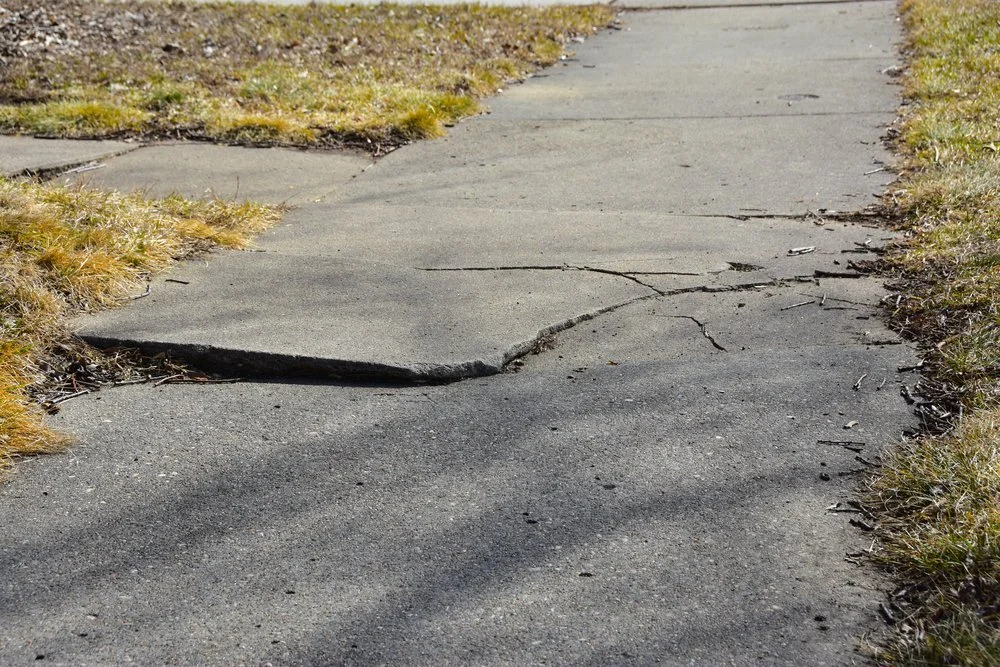
Cracked sidewalks, deteriorated curbs, and poorly maintained public walkways are a real hazard in older Nevada County communities. Claims against cities and the county require acting fast — the six-month administrative claim deadline applies. We identify the responsible entity and move immediately.
Parking lots and commercial entrances
Potholes, unmarked curbs, poor lighting, and weather-related hazards in commercial parking lots cause serious falls that property owners routinely try to minimize. The owner's duty extends to the entire property — including the lot, entryways, and walkways.
Stairs and elevated surfaces
Broken handrails, uneven risers, inadequate lighting on stairs, and unmarked elevation changes are among the most dangerous and most preventable premises hazards. Building code violations often establish liability directly — without needing to prove the owner knew about the specific defect.
Trip and fall questions — answered plainly
The insurance company says I should have watched where I was walking. Does that end my claim?
No — and this is exactly what they want you to believe. California's pure comparative fault rule means you can still recover even if you were partially inattentive. The property owner's duty to maintain safe premises doesn't disappear because a visitor was walking normally. The real question is whether the hazard was unreasonably dangerous — not whether you were perfectly attentive.
Does the property owner have to have known about the hazard?
Not necessarily. Constructive knowledge — meaning they should have known through reasonable inspection — is enough. A cracked sidewalk that has existed for months, a recurring wet floor condition, a broken step that was never repaired — these are conditions a reasonable owner conducting regular inspections would have found and fixed.
How important is it to document the scene right away?
It is critically urgent. Property owners routinely repair dangerous conditions within hours of an accident to avoid liability. The exact hazard that caused your fall may not exist tomorrow. Photograph everything before you leave if you possibly can — the hazard itself, the surrounding area, lighting conditions, any warning signs or the absence of them.
What if I fell on a public sidewalk in Grass Valley or Nevada City?
Claims against government entities — cities, counties — require filing an administrative claim within six months of the injury, not two years. This is a hard deadline. Missing it permanently bars your claim. If your fall happened on public property of any kind, contact an attorney immediately.
How long do I have to file a trip and fall lawsuit?
For falls on private property, California's statute of limitations is generally two years from the date of injury. For falls on government property, six months for the administrative claim. Beyond the legal deadline, evidence disappears fast in these cases — contact an attorney promptly regardless of the timeline.
What damages can I recover in a trip and fall case?
Medical expenses past and future, lost wages, reduced earning capacity, pain and suffering, and loss of enjoyment of life. Trip and fall injuries can be serious — broken hips, wrist fractures, head injuries, and knee injuries are common — and the full impact deserves full compensation.
Don't let them tell you
it was your fault.
Free consultation. No obligation. If you've been injured in a trip or fall in Nevada County, call before you talk to their insurance company.
Call Michael: (530) 265-0186Prefer email? mp@phillipspersonalinjury.com | 305 Railroad Ave., Suite 5, Nevada City, CA